

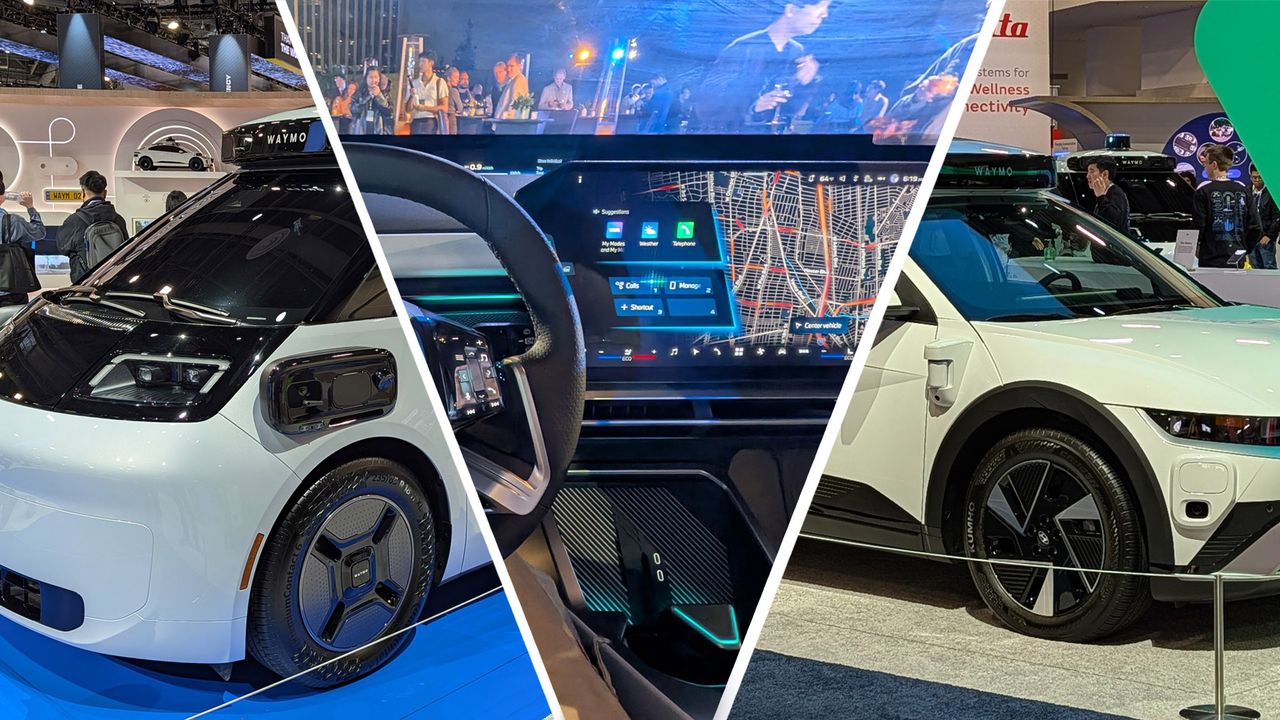
It’s no secret that in recent years, CES has turned into a bit of an automotive show, with car manufacturers, suppliers, and partners displaying the latest in infotainment, autonomous driving, and EV tech. At this year’s CES, the automotive focus clearly shifted towards physical AI and robotaxis. So let’s dive into the most interesting car tech I saw at CES 2026.
Qualcomm Snapdragon Ride Flex platform
Most vehicles on the roads today use separate computers for infotainment and ADAS (advanced driver assistance system). This is done for safety, since you don’t want your car suddenly veering into a ditch because your music player crashed. On the flip side, having two computers, often with chips from separate vendors, increases complexity and cost.
Qualcomm’s Snapdragon Ride Flex platform solves this problem by combining infotainment and ADAS into a single SoC without compromising safety. The guardrails between the two domains are handled with the same kind of mission-critical, real-time software used in aerospace. Another benefit of Qualcomm’s unified platform is power efficiency and flexibility.
Snapdragon Ride Flex is able to scale from basic, economy cars all the way up to expensive, luxury vehicles. Beyond combining infotainment and ADAS functionality into a single chip, it also provides support for GPS navigation and routing, AI voice assistants, 3D rendering for complex on-screen graphics, 5G connectivity, and even driver monitoring.
Basically, Snapdragon Ride Flex applies Qualcomm’s smartphone and mobile SoC expertise to modern SDVs (software defined vehicles). It supports ADAS in cars equipped with as little as one forward-facing camera, a single front radar unit, and a driver monitoring camera, to vehicles integrating multiple cameras, radar units, lidar sensors, and high-definition maps.
At CES 2026, Qualcomm was demoing the Snapdragon Ride Flex platform in a modified Lincoln Aviator, but the chip is used in vehicles recently launched in China, like the ARCFOX Alpha T5 and Dongfeng Nissan N6, and will soon be coming to US-market cars.
[Disclaimer: Qualcomm provided accommodations and meals for my trip to CES 2026, but did not offer any other compensation and did not have any editorial control over my content.]
BMW iX3 Alexa+ integration
If you have an Echo smart speaker at home, you’re probably familiar with Alexa+, Amazon’s LLM-powered voice assistant. The company wants to bring its generative AI tech to more devices, including cars.
At CES 2026, BMW announced that it’s partnering with Amazon to bring Alexa+ to its Neue Klasse EVs starting with the iX3 electric SUV later this year.
Alexa is already widely available in modern vehicles, but the iX3 is the first car to incorporate a customized version of Alexa+. This integration lets you have a natural conversation with your car by saying “Hey, BMW.” You can ask for a drugstore on the way to your destination or for food recommendations near you, and you can ask about the weather or current news.
You can even ask the voice assistant to play music, adjust the climate, or control your smart home devices. Alexa+ remembers context, so you can start a conversation on your Echo at home and continue where you left off in your BMW. That’s nice, but voice assistants in cars have mostly been frustrating so far, and people avoid using them – myself included.
I was able to experience BMW’s Alexa+ integration for myself at CES, and it’s definitely an improvement over previous in-vehicle voice assistants. You even get a cute little animated talking head in the middle of the iX3’s Panoramic Display when the AI responds. While the experience was mostly glitch-free, it was clearly still a work in progress.
The biggest issue I see with this integration is that you’re stuck with Alexa+. If you prefer using Gemini for your voice assistant – as I do – or ChatGPT, you’re out of luck. None of your chat history and AI context follows across devices, and that’s a major limitation.
Waymo Ojay electric robotaxi
Autonomous driving and robotaxis were all over CES 2026. Amazon’s Zoox autonomous pod is already operating in Las Vegas, Lucid debuted a Gravity robotaxi in partnership with Nuro and Uber, and Tensor displayed its robocar in collaboration with Lyft. But the star of the show was definitely Waymo’s Ojay robotaxi, the van formerly known as Zeekr RT.
Now in its final form, the Ojay robotaxi looks almost identical to the Zeekr RT Waymo showcased at CES 2025, and is being tested in several of the company’s markets, including my neighborhood in San Francisco. This electric AV (autonomous vehicle) will complement and eventually replace Waymo’s existing fleet of Jaguar i-Pace autonomous EV.
The van, which is built on Zeekr’s SEA-M 800V architecture, packs a 76kWh lithium-iron phosphate battery and boasts a spacious pillar-less design. After being assembled by Zeekr in China, it’s outfitted with Waymo’s sensor suite here in the US. This sensor suite consists of 13 cameras, six radars, four lidars, and an array of external microphones.
If you’re counting, that’s less than half the number of cameras on Waymo’s current Jaguar i-Pace. Heaters, sprayers, and tiny wipers keep the sensor suite clean in inclement weather. And, unlike prototypes, the Ojai robotaxi still features pedals and a steering wheel. Waymo’s other new robotaxi, based on Hyundai’s IONIQ 5 EV, was also on display at CES.
I use Waymo quite regularly, so I’m looking forward to riding in the new Ojay robotaxi when it finally enters service in San Francisco later this year. Keep an eye out for my first impressions.
Donut Lab solid-state battery
Solid-state batteries have been hyped as the Next Big Thing (™) for years now, but have never left the lab – until now, apparently. At CES 2026, Donut Lab, the Finnish company best known for its power-dense hubless in-wheel electric motors, showcased the “world’s first” solid-state battery used in a production EV, namely the Verge Motorcycles’ TS Pro ($30,000+).
Obviously, let’s take Donut Lab’s claim with a grain of salt. Solid-state batteries are the holy grail of battery tech – cells that are energy dense, lightweight, affordable, and charge fast, run cool, and don’t turn into a fiery mess when damaged or abused. Imagine getting 30 percent more range from an EV with a solid-state battery pack of identical size and weight.
I’m taking game-changing tech here. Here’s what we know about Donut Lab’s solid-state battery. A single 125Wh cell consists of a prismatic pouch the size of a large smartphone and delivers a whopping 400Wh/kg of energy density. Forty cells can be arranged into briefcase-like 5kWh modules that offer 350Wh/kg of energy density and weigh 14kg (30.8lbs).
The icing on the cake (ahem) is that Donut Lab promises a lifespan of 100,000 charge cycles for its solid-state battery, vs. 1,500 charge cycles for a modern lithium-ion cell. As for Verge Motorcycle’s TS Pro, it packs up to 33kWh of Donut Lab’s solid-state batteries, delivers 370mi of range, charges at 200kW, and reaches 62mph in 3.5sec. That’s some tasty stuff.
Ultimately, it remains to be seen if Donut Lab can mass-produce its solid-state batteries in quantities beyond those required by a boutique electric motorcycle manufacturer. Time will tell.
That’s (not) all, folks
So here you go. This is the car tech that stood out for me at CES 2026. But obviously, I’m just scratching the surface here. There were other interesting automotive goodies to sample at this year’s show, like Longbow Motors’ Speedster EV, iM Media Labs’ partnership with AT&T, Sony Honda Mobility’s Afeela EV (yet again), and Strutt’s EV1 autonomous mobility scooter.
Follow TechRadar on Google News and add us as a preferred source to get our expert news, reviews, and opinion in your feeds. Make sure to click the Follow button!
And of course you can also follow TechRadar on TikTok for news, reviews, unboxings in video form, and get regular updates from us on WhatsApp too.


