Why you can trust TechRadar
We spend hours testing every product or service we review, so you can be sure you’re buying the best. Find out more about how we test.
Seagate FireCuda 530R with heatsink: One-minute review
The Seagate FireCuda 530R with heatsink could be one of the best SSDs for PS5 but, at least for the moment, the pricing is out of control. The 1TB model is difficult to find, while the 2TB and 4TB variants come in at an eye-watering $365 / £220 and $599 / £539.99 respectively at third party sellers on sites like Amazon and Newegg.
Pricing aside, the Seagate FireCuda 530R with heatsink is a solid, if somewhat unremarkable, PS5 SSD. With quoted read speeds of up to 7,400 MB/s read and 7,000 MB/s write (for the 1TB model) it’s one of the fastest models on the market on paper – though I found its performance to be less impressive in the real world than these figures would suggest.
The 2TB model that I tested scored an underwhelming 6,030MB/s speed on the internal PS5 storage benchmark putting it behind both the WD Black SN850P and Lexar NM790 with Heatsink, not to mention the company’s own officially licensed Seagate Game Drive M.2 SSD for PS5. Still, it’s comfortably above the 5,500 MB/s speed recommended by Sony and doesn’t increase loading times in any noticeable way.
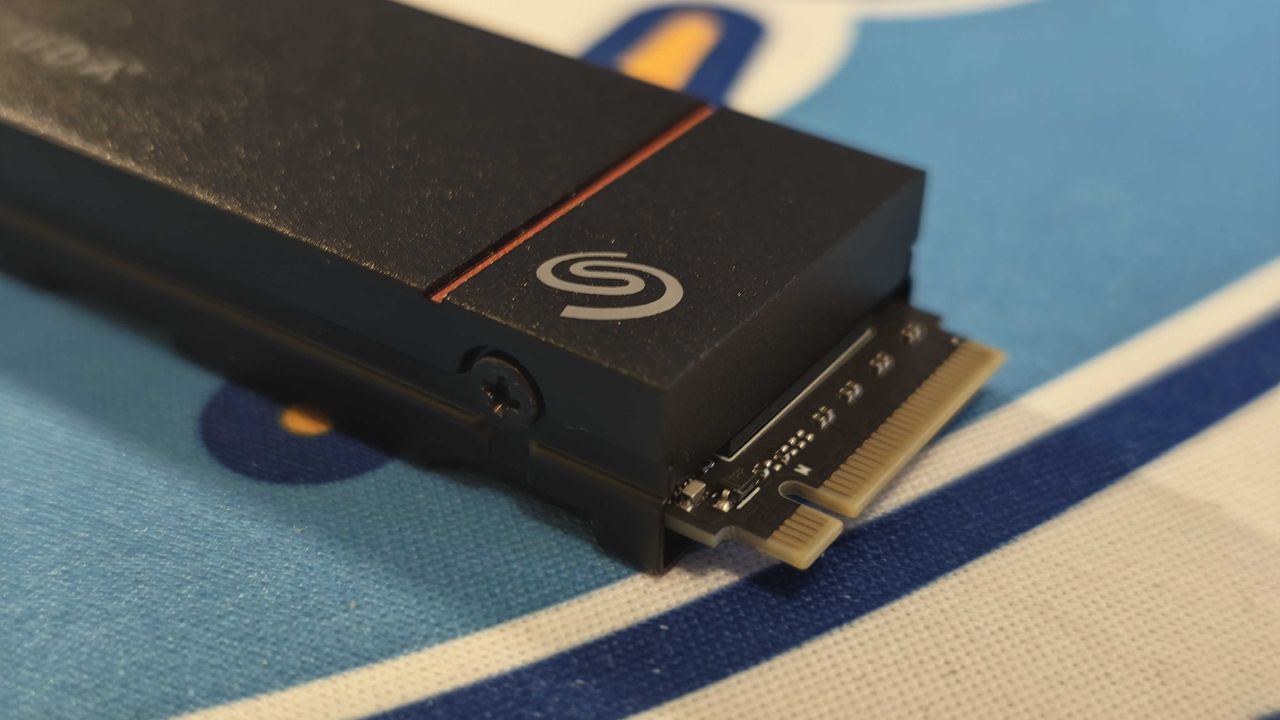
As you would expect for a model marketed towards PS5 owners, the Seagate FireCuda 530R with heatsink comes with a chunky heatsink fitted out of the box. It’s very similar to the one found on the Seagate Game Drive M.2 SSD – albeit with a colorful orange line graphic rather than a blue one. As is the case with that drive, I found it to be perfectly effective.
As a result, the Seagate FireCuda 530R with heatsink could be a great pick for the right price. At the moment, I wouldn’t rush to add it to your basket though given the inflated rates.
Seagate FireCuda 530R with heatsink: Price and availability
- 1TB is $130 / £145 / around AU$290, 2TB is $365 / £220 / around AU$440, 4TB is $599 / £539.99 / around AU$1080
- Prices vary and are hard to pin down
- Stock is hard to find in the US and UK
In the US the Seagate FireCuda 530R with heatsink costs around $130 for the 1TB model – though I wasn’t able to find any retailers carrying stock of that variant at the time of writing. 2TB and 4TB models are easier to find though with stock available at Newegg. There, 2TB goes for $365, while 4TB is $599. Both of these prices come from a third-party seller and are disproportionately high, so I would avoid buying them for now.
In the UK it’s even harder to find, as it’s currently out of stock at Amazon. Historical price data shows that the 1TB model cost around £145, while the 2TB was £220 when both were in stock. The 4TB model is currently available at Overclockers UK, where it costs £539.99.
Seagate told me that a 1TB model of the drive is currently meant to cost $114.99 / £158.99, while 2TB and 4TB are supposed to be $194.99 / £271.99 and $394.99 / £516.99 respectively – though the representative was careful to clarify that “SSD prices are currently very volatile” and “can change daily” (that latter part was even in bold for emphasis).
Seagate FireCuda 530R with heatsink: Specs
|
Price |
$130 / £145 / around AU$290 (1TB) / $365 / £220 / around AU$440 (2TB) / $599 / £539.99 / around AU$1080 (4TB) |
|
Capacity |
1TB / 2TB / 4TB |
|
Quoted read speed |
7,400 MB/s |
|
Quoted write speed |
7,000 MB/s |
|
Durability |
5,050 TBW |
|
Warranty |
5-year |
Seagate FireCuda 530R with heatsink: Design and features
- Chunky heatsink fitted out the box
- Readily PS5 compatible
- Good warranty coverage
The Seagate FireCuda 530R with heatsink looks remarkably similar to the Seagate Game Drive M.2 SSD for PS5, though with some small aesthetic differences. For starters, the chunky heatsink of the FireCuda bears a little ‘FireCuda’ logo print and a subtle orange decal. Despite the size of the heatsink, this model easily fits into the PS5’s storage bay.
It comes well-packaged in a plastic tray with a little foam insert to keep the pins safe and a little pack of documentation. In there you’ll find an advert for Seagate’s Rescue data recovery service, a basic manual with some general advice on fitting the SSD, and information about the drive’s warranty.
In applicable regions you get five years of limited warranty coverage here, which should be enough to see you through the rest of the PS5’s lifespan and is on par with what’s offered by the competition. The drive’s quoted 5,050 TBW durability is also excellent.
Seagate FireCuda 530R with heatsink: Performance
- Underwhelming benchmark score
- Decent real-world performance
- Heatsink seems effective
Despite the lofty quoted speeds, the Seagate FireCuda 530R with heatsink achieved quite an underwhelming result in the PS5’s internal storage benchmark coming to just 6,030MB/s which is on the lower end of the results for SSDs that I’ve tested. Still, this is more than fast enough for the PS5 and in my testing didn’t impact playing in any noticeable way.
While the substantially cheaper Lexar NM790 with Heatsink caused occasional stutters in demanding games like Marvel’s Spider-Man 2 and Assassin’s Creed Valhalla, the Seagate FireCuda 530R with heatsink was silky smooth in every title that I tested.
Its performance in my usual real-world file transfer tests was also decent. Copy to the SSD from the PS5’s internal storage, 68.75GB of Warhammer 40,000: Space Marine 2 took just 44 seconds to transfer. The drive performs very well with even larger file sizes too, with the 86.33GB Ghost of Yotei copied in just 45 seconds. A combination of both games totaling 154.7GB only took 1 minute and 24 seconds.
Smaller titles were a little bit slower, with the 16.85GB Wuchang: Fallen Feathers taking eight seconds and the tiny 1.2GB C Smash VRS taking just two.
Copying from the SSD back to the console, Warhammer 40,000: Space Marine 2 and Ghost of Yotei were ready in 4 minutes and 41 seconds and 6 minutes and 5 seconds respectively, while both at once took 10 minutes and 17 seconds. Finally, Wuchang: Fallen Feathers was ready to launch after 1 minute and 13 seconds while C Smash VRS took 13 seconds. These figures are all perfectly adequate, though realistically more dependent on the PS5’s internal write speed than anything else.
There was no noticeable slowdown throughout my testing, which would indicate that the chunky heatsink does its job well and curbs thermal throttling.
Should I buy the Seagate FireCuda 530R with heatsink?
Buy it if…
Don’t buy it if…
Also consider…
After some alternatives to the Seagate FireCuda 530R with heatsink? Here are two to consider.
| Row 0 – Cell 0 |
Seagate FireCuda 530R with heatsink |
Lexar NM790 with Heatsink |
WD Black SN850P |
|
Price |
$130 / £145 / around AU$290 (1TB) / $365 / £220 / around AU$440 (2TB) / $599 / £539.99 / around AU$1080 (4TB) |
$94.99 / £74.99 (1TB) / $159.99 / £129.99 (2TB) / $269.99 / £233 (4TB) |
$119.99 / £107.99 / AU$199 (1TB), $189.99 / £184.99 / AU$339 (2TB), $319.99 / £329.99 / AU$699 (4TB), $749.99 / £705.99 / around AU$1,170 (8TB) |
|
Capacity |
1TB / 2TB / 4TB |
1TB / 2TB / 4TB |
1TB / 2TB / 4TB / 8TB |
|
Quoted read speed |
7,400 MB/s |
7,400 MB/s |
7,300 MB/s (8TB: 7,200 MB/s) |
|
Quoted write speed |
7,000 MB/s |
6,500 MB/s |
6,600 MB/s |
|
Durability |
5,050 TBW |
1000TBW (1TB) / 1500TBW (2TB) / 3000TBW (4TB) |
600TBW (1TB) |
|
Warranty |
5-year |
5-year |
5-year |
How I tested the Seagate FireCuda 530R with heatsink
- Tested for a week
- Tried with multiple games
- Compared to other PS5 SSDs
I tested the Seagate FireCuda 530 with heatsink for a week, fitting it to my personal PS5 console. During that time I evaluated its performance with a range of copy tests, in addition to recording the console’s internal benchmark score and trying it with a range of installed games to determine whether the SSD would cause any impact on smoothness.
Throughout my time with the SSD I compared the experience to my hands-on testing of other models including the Samsung 990 Pro with Heatsink, WD Black SN850P, Lexar NM790 with Heatsink, Seagate Game Drive M.2 SSD for PS5, Lexar Play 2280 and more.
First reviewed January 2026