Why you can trust TechRadar
We spend hours testing every product or service we review, so you can be sure you’re buying the best. Find out more about how we test.
Razer Kishi V3 Pro review: Two-minute review
The Razer Kishi V3 Pro is a very capable mobile controller that comes with reliable and remappable inputs, a comfortable form factor, great software, and a very high price tag. It’s a top choice for those who want a console-style experience on the go thanks to its great analog triggers, full-size thumbsticks, and intuitive design, but doesn’t quite feel as sturdy as a dedicated standalone controller.
The Kishi V3 Pro costs as much as the outgoing Razer Kishi Ultra did at launch – that is to say more than most mobile gaming controllers and nearly as much as a Nintendo Switch Lite. That said, the Kishi V3 Pro is a way to access a console-like gaming experience for less than a dedicated gaming handheld, so long as your phone is powerful enough to run your favorite titles.
Razer Kishi V3 Pro review: Price & availabiltiy
- $149.99 / £149.99 / AU$269.95
- Available from Razer and third-party retailers
- More expensive than many mobile and standalone controllers
The Razer Kishi V3 is a rather expensive bit of kit. In fact, it’s more expensive than any of the options on our list of the best mobile controllers except the outgoing Razer Kishi Ultra, which comes in at the same RRP. With that said, the Kishi V3 Pro offers more functionality than many of its rivals, with additional shoulder buttons and paddles on the grips.
The Kishi Ultra has been relegated to the ‘Classic Models’ section of Razer’s website, but can still be had at a discounted price in the UK and US as stock is cleared to make way for the new Kishi V3 Pro, and considering that the two controllers offer nearly the exact same functionality, it could be worth checking for deals on the older model before looking for the Kishi V3 Pro.
You should have no issues getting your hands on the Razer Kishi V3 Pro, as Razer is one of the most popular and widely distributed gaming brands – it just depends on how much money you’re willing to spend. As was the case for the Kishi Ultra, the Nintendo Switch Lite comes in at just $50 / £50 / AU$60 more than the Kishi V3 Pro, which offers a more dedicated handheld gaming platform with a large library of exclusive games.
However, I’d argue that the Kishi V3 Pro unlocks handheld-style gaming for the phone you probably already have, for a bit cheaper than a dedicated console. Through this lens, I think the Kishi V3 Pro offers decent value for money.
Razer Kishi V3 Pro review: Specs
|
Price |
$149.99 / £149.99 / AU$269.95 |
|
Dimensions |
110.8 mm X 244.8 mm X 64.3 mm |
|
Weight |
0.59lbs / 268g |
|
Connection type |
Wired (Type-C) |
|
Compatibility |
iPhone, iPad Mini, Android |
|
Software |
Razer Nexus App (iOS / Android) |
Razer Kishi V3 Pro review: Design and features
- Resembles the Razer Kishi Ultra
- Extends up to eight inches
- Can fit small tablets
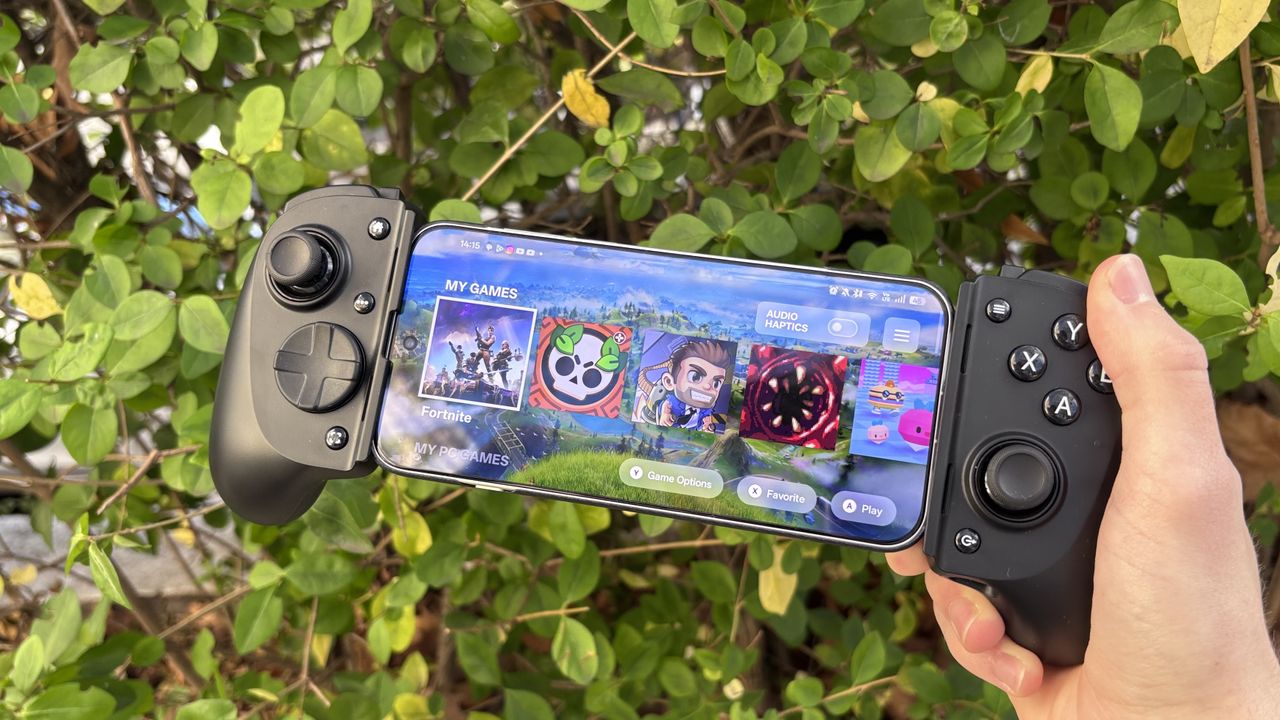
The Razer Kishi V3 Pro is an extending mobile controller that closely resembles a Razer Kishi Ultra, just without the RGB light strips in the handles.
It’s composed of a regular controller that’s been split down the middle by a spring-loaded extending spine with a maximum length of eight inches. That means it can accommodate any phone, so long as it has a USB-C port to connect to the controller, as well as the iPad mini. The controller comes with three pairs of rubber cushions which you can mix and match between to suit your handset, or eschew entirely if your phone is too bulky.
The two controller halves use the asymmetrical design that Xbox and Nintendo Switch fans will be used to, but even as a PS5 player I found the Kishi V3 Pro very comfortable to hold and use. The grips are rounded but substantial, and while the whole thing is made of plastic the textured panels on the grips themselves are a welcome addition and add valuable traction to what is overall a compact control surface – with that said, the Kishi V3 Pro is large enough to need a bag if you’re taking it out and about.
The construction of the Kishi V3 Pro isn’t quite as robust as a standalone controller, though, and the controls themselves are a mixed bag in terms of feel.
I love the resistance in the adaptive shoulder triggers (an impressive feature on its own), but the adjacent bumpers have no travel at all – similarly, I love the dish-like design of the D-pad but not its clicky action. I was, however, impressed with the smoothness of the full-sized thumbsticks and encountered no sticking or drifting in my 10 or so hours with the Kishi V3 Pro. The sticks are reasonably tall and feel very precise during gameplay.
On that note, the best thing about the Kishi V3 Pro is just how much control it offers. As well as your standard layout, the Kishi V3 Pro sports assignable back and shoulder buttons, which can be mapped to mirror any other button on the controller via the free Razer Nexus app. These buttons are thoughtfully placed and genuinely useful, allowing you to, say, reload without having to stop aiming in Call of Duty: Mobile, or quickly open the map in Fortnite. I never experienced any issues in-game that I’d blame on the controller – it’s very reliable and responsive. There are also some bespoke controls in the small hom escreen, screenshot, and Razer Nexus buttons, all of which are welcome additions.
As mentioned, the Razer Kishi V3 Pro connects via USB-C, and sports a handy LED that lights up when a connection is made. As well as connecting your phone or tablet to the controller, this USB-C connection allows for pass-through charging via another USB-C port and audio via a dedicated 3.5mm jack – a rare sight on any phone accessory and holy grail for headset users. That USB-C port can also be used to connect the Kishi V3 Pro to a PC to use as a standalone wired controller.
And if you’re an Android user, you’ll get to experience Razer’s Sensa HD haptics. The Kishi V3 Pro offers an impressive amount of rumble, with more precision than I expected to feel from a mobile controller – but because the haptics respond to in-game audio, there is a bit of a delay between on-screen action and feeling the aftershock. This feature is unavailable on iOS, but since most of the best gaming phones are Android models anyway, I’m sure this feature will find many fans.
Razer Kishi V3 Pro review: Performance
- Console quality gaming on the go
- Fantastic Nexus software
- Hit and miss virtual controller mode
As someone who has only gamed seriously on dedicated consoles up until this point, I was surprised by just how immersive using the Kishi V3 Pro felt.
The frame holds your phone in place sturdily and lets you focus on the important stuff – the games themselves. Like all the best controllers, the Kishi V3 Pro is so reliable that it disappears into your hands and makes you feel connected to the game – inputs are always accurate and responsive.
That unlocks a lot of potential for mobile games like Red Dead Redemption, which is playable on a touch screen, but offers a much better experience when you can aim accurately and take in the gorgeous visuals with an unobstructed view. Having spent a good amount of time riding through the deserts of New Austin in Red Dead Redemption 2 for PS4, I was surprised at how similar the two experiences felt.
I spent plenty of time with the Kishi V3 Pro in the newly released Fortnite: Chapter 7, running and gunning in Zero Build Battle Royale. I was able to get a competitive edge thanks to the precision of the thumbsticks for moving and aiming, as well as the mappable multi-function buttons (I assigned the map and pickaxe to the shoulder bumpers and slide and weapon select to the back buttons).
Again, I was quite amazed at how close the experience felt to playing on an actual console, and was clocking up Victory Royales like it was nobody’s business. What’s more, I was able to play for hours at a time without so much as a sign of cramp – if you’re looking for a mobile controller that’s comfortable enough for marathon sessions, the Kishi V3 Pro is a great pick. I’d even suggest that it’s more comfortable than my original Nintendo Switch.
The Kishi V3 Pro, like other Razer mobile controllers, supports and is supported by the Razer Nexus app, a launcher and hub for your compatible mobile games. Nexus also lets you toggle XInput and audio haptics before jumping into your game of choice, set favorite games, and browse popular Kishi-compatible titles, with easy links to the Google Play Store or App Store.
The app also offers the inventive Virtual Controller mode, which allows you to overlay controls on unsupported titles, effectively allowing you to play games that don’t support the Kishi V3 Pro natively.
However, Virtual Controller didn’t always respond well when I tested the mode on Brawl Stars, despite Razer Nexus highlighting the game as a great candidate, and I couldn’t figure out how to get Alto’s Adventure (also highlighted) to respond either. TechRadar’s Gaming Editor Dashiell Wood had Virtual Controller up and running during testing for our Kishi Ultra review, so I know the potential is there, but I didn’t find it too effective.
As someone who typically avoids tacked-on software, I’m happy to report that Nexus is anything but an afterthought – in fact, it’s a thoughtfully laid-out and feature rich companion that helps you get the most out of the Kishi V3 Pro.
I used its settings to remap the multi-function buttons and increase the polling rate of the thumbsticks, but there are also settings for things like the input range for the triggers or setting thumbstick deadzone size. It’s a great app that elevates the Kishi V3 Pro from a peripheral to an experience of its own.
Should I buy the Razer Kishi V3 Pro?
Buy it if…
Don’t buy it if…
Also consider
Consider these alternatives if the Razer Kishi V3 Pro isn’t quite the right mobile gaming controller for you.
| Row 0 – Cell 0 |
Razer Kishi V3 Pro |
Backbone One 2nd Gen |
Asus ROG Tessen |
|
Price |
$149.99 / £149.99 / AU$269.95 |
$99.99 / £99.99 / AU$179.99 |
$109.99 / £109.99 / AU$179 |
|
Dimensions |
110.8 mm X 244.8 mm X 64.3 mm |
6.93 in x 3.70 in x 1.34 in / 176mm x 93.98mm x 34.03mm |
7.5 in x 3.6 in x 1.5 in / 191.5 mm x 92 mm x 40 mm |
|
Weight |
0.59lbs / 268g |
0.30 lbs / 138 g |
0.29 lbs / 136 g |
|
Connection type |
Wired (Type-C) |
Wired (Type-C / Lightning) |
Wired (Type-C) |
|
Compatibility |
iPhone, iPad Mini, Android |
iPhone 15 Series, Android / iPhone 14 series, and earlier |
Android |
|
Software |
Razer Nexus App (iOS / Android) |
Backbone App (iOS / Android) |
Armoury Crate (Android) |
How I reviewed the Razer Kishi V3 Pro
- Tested for approximately 8 hours of game time
- Tested on Android and iOS with a range of games
- Almost ten hours of game time
- Tested with a variety of games
- Tried a range of devices too
Though I wasn’t counting closely, I estimate that I clocked in for approximately 8 hours of game time with the Razer Kishi V3 Pro across a variety of games.
I tested the controller with an iPhone 15 and Oppo Find X9 Pro to ensure it works well across both iOS and Android, as well as with the Xiaomi Pad Mini Android tablet. I played a variety of games, from demanding console ports like Fortnite and Red Dead Redemption to staples like Call of Duty: Mobile and Jetpack Joyride. I also tried out platformer Dadish 3D and horror side-scroller Carrion, and tested the Virtual Controller mode with Brawl Stars.
I focused on first and third-person games to get a good sense of the thumbsticks’ performance, and played competitive online games to test how the controls held up in high-pressure scenarios. I also tested the 15W pass-through charging and headphone jack, and dove deep into the Razer Nexus app to activate features like the multi-function buttons and audio haptics.
First reviewed December 2025