

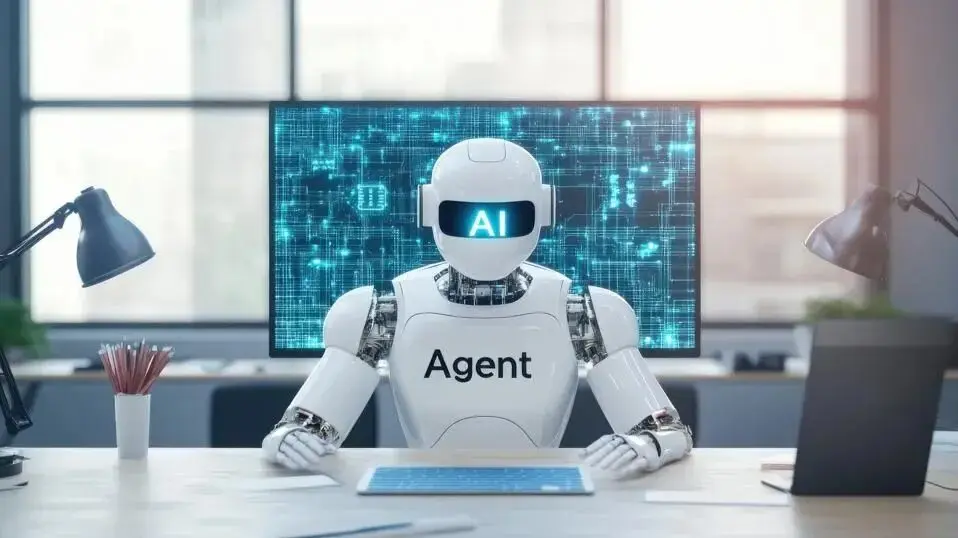
You’ve likely heard of agentic AI by now: systems that can autonomously plan, execute, and adapt across tasks with “minimal” human oversight (quotations intentional here). In this, we’ve seen a shift from AI as a mere tool to now AI as a collaborator.
However, there is also a growing tension: Agentic AI needs deep access to your data to act autonomously, but that level of access makes it hard to deploy safely and responsibly at scale.
CEO and co-founder at KNIME.
Most enterprises don’t struggle to build agentic systems — they struggle to trust them.
In this article, we’ll explore three risks holding agentic AI back from enterprise-readiness, especially when it comes to agents working with data, and then three ways intuitive, low-code workflows can turn these systems into reliable colleagues.
Workflows don’t limit the “intelligence” of agentic AI, but rather, act as a “safe layer” between agentic AI and your data, making it possible to operationalize agentic AI in the enterprise.
Risk #1: No transparency in decision making
Most AI agents today rely on LLMs as the planners or “brains” behind the scenes. This means most agents don’t follow predefined blueprints or logic. The way they work is dynamic and always changing. Their actions are based on likelihood derived from vast datasets — not knowledge.
We’ve all seen it: an AI telling us what we want to hear instead of what’s true, simply because we (subconsciously or not) led it in the wrong direction with our responses. Think of that famous example where someone convinced an AI that 2+2=5.
The result? These actions are difficult to inspect, explain, or trace. Without a clear, visible audit trail, enterprises cannot confidently answer a critical question: “Why did the agent do that?” Especially when the agent takes an unexpected action.
Ultimately, this makes debugging challenging, and likely miserable. Instead of systemic debugging, enterprise teams have the time-consuming task of second-guessing the agent’s behavior. This slow, manual, error-prone, unscalable process of “prompt forensics” is ineffective for enterprises.
If you can’t trace it, you can’t trust it. And on the topic of trust…
Risk #2: Indeterminism means no operational trust
Agentic AI is not deterministic, which means it doesn’t produce consistent, repeatable outputs. Identical tasks could yield different actions. In addition, agents could hallucinate actions based on what could be plausible, but end up being just plain wrong.
And there is often no built-in layer to enforce or constrain what an agent can or can’t do.
This is particularly high-risk for enterprises, like financial systems or anything touching personal data, where data leakage is unacceptable. Especially in those cases, lack of consistency, transparency, explainability, and control ultimately leads to lack of trust.
Risk #3: No clear boundary between data and AI
In traditional enterprise systems, data and logic are clearly separated. IT teams know where the data is stored, how it’s accessed (whether through permissions or trust), and there’s an explicit code or set of rules that govern how this data is used.
Agentic systems break these rules. They blend reasoning, knowledge, and actions into an opaque process. Drawing a clear boundary line between what information the agent has access to versus what the agent does can be challenging, and in some instances, impossible.
The lack of separation is not only high-risk — it’s a dealbreaker. Enterprises are legally required to meet compliance and governance standards. This lack of a clear boundary discourages enterprises from AI adoption.
So, what can we do to mitigate these risks and (safely) benefit from agentic AI — and encourage adoption — in business? Or better yet, how can agents reliably work with data?
Workflows as a unifying language and bridge for enterprises and agentic AI
The answer lies in transparency. Intuitive, low-code workflows bring in that transparency, acting as a clear separation between agents and your data. Workflows force agents to interact with tools, not directly with the data.
While agentic systems are powerful because they can reason with minimal human input, workflows rein in that power and build trust by setting a defined, structured path for how these agentic systems can operate. Workflows bring control, clarity, and repeatability to dynamic and uncertain systems.
1. Workflows allow for auditability
Workflows being visual in nature, each step — and each potential failure point — is more visible. The decision-making process is more clearly documented. The outputs are controllable and explainable.
Also, the visual nature of workflows makes it an intuitive format. It allows teams with varying levels of technicality to have the ability “to speak the same language,” in contrast to a mess of SQL, Python, or other code that other solutions may come with.
This makes debugging and monitoring much more straight-forward for enterprise teams.
2. Workflows allow for trustworthy guardrails and reusability
Workflows reduce risk because workflows set what data and tools agentic systems can access, and in what level of detail. Decision-makers can define this explicitly company-wide.
Additionally, once these approvals and logic have been set, workflows allow for reusability and scalability. Enterprises can reuse these validated blueprints and implement workflows into other parts of the business without reinventing the wheel — or at the very least, be a reliable starting point for other projects.
3. Workflows allow for governance and accountability
Workflows enforce guardrails, observability, and accountability. By being the clear separation between data and AI (Remember, what the agent knows versus what the agent does), enterprises have complete governance. Organizations can protect data, monitor data access, and audit data lineage.
Put simply: Workflows make sure agentic AI uses your data properly… and doesn’t abuse it!
Agentic AI is undeniably valuable in the enterprise context. Even with these risks, there doesn’t have to be a tradeoff between transparency and complexity. By enforcing workflows as the safety layer to your agentic work, you allow for visual, modular, and governable ways to build intelligent agents that enterprises can trust and scale.
Again: You don’t give agents access to your data. You give agents access to your tools, which keeps your data protected from attacks or misuse. Agentic AI is not limited by workflows.
Rather, these systems have more “freedom” to do cool things when operating within the data-safe boundaries of well-defined workflows as a language. And as a sidenote: This is nicely in line with newer trends to provide agents with sets of skills instead of detailed instructions on how to use hundreds of tools.
Just like Pat Boone once said, “Freedom isn’t the absence of boundaries. It’s the ability to operate successfully and happily within boundaries.”
We’ve featured the best business intelligence platform.
This article was produced as part of TechRadarPro’s Expert Insights channel where we feature the best and brightest minds in the technology industry today. The views expressed here are those of the author and are not necessarily those of TechRadarPro or Future plc. If you are interested in contributing find out more here: https://www.techradar.com/news/submit-your-story-to-techradar-pro


